University-led research shows stronger academic results among Duke of Ed students, in addition to the known personal development benefits.
A landmark study by Western Sydney University has confirmed what many educators and Duke of Ed Leaders have long observed: young people who use the Duke of Ed Framework develop stronger personal capabilities and achieve better academic results.
The comparative study, using five NSW public secondary schools, examined several data points including academic grades, NAPLAN scores, student surveys and focus group insights. The research design ensured that students using and not using the Duke of Ed Framework began on equal academic footing with no differences in baseline ability.

Stronger Academic Outcomes
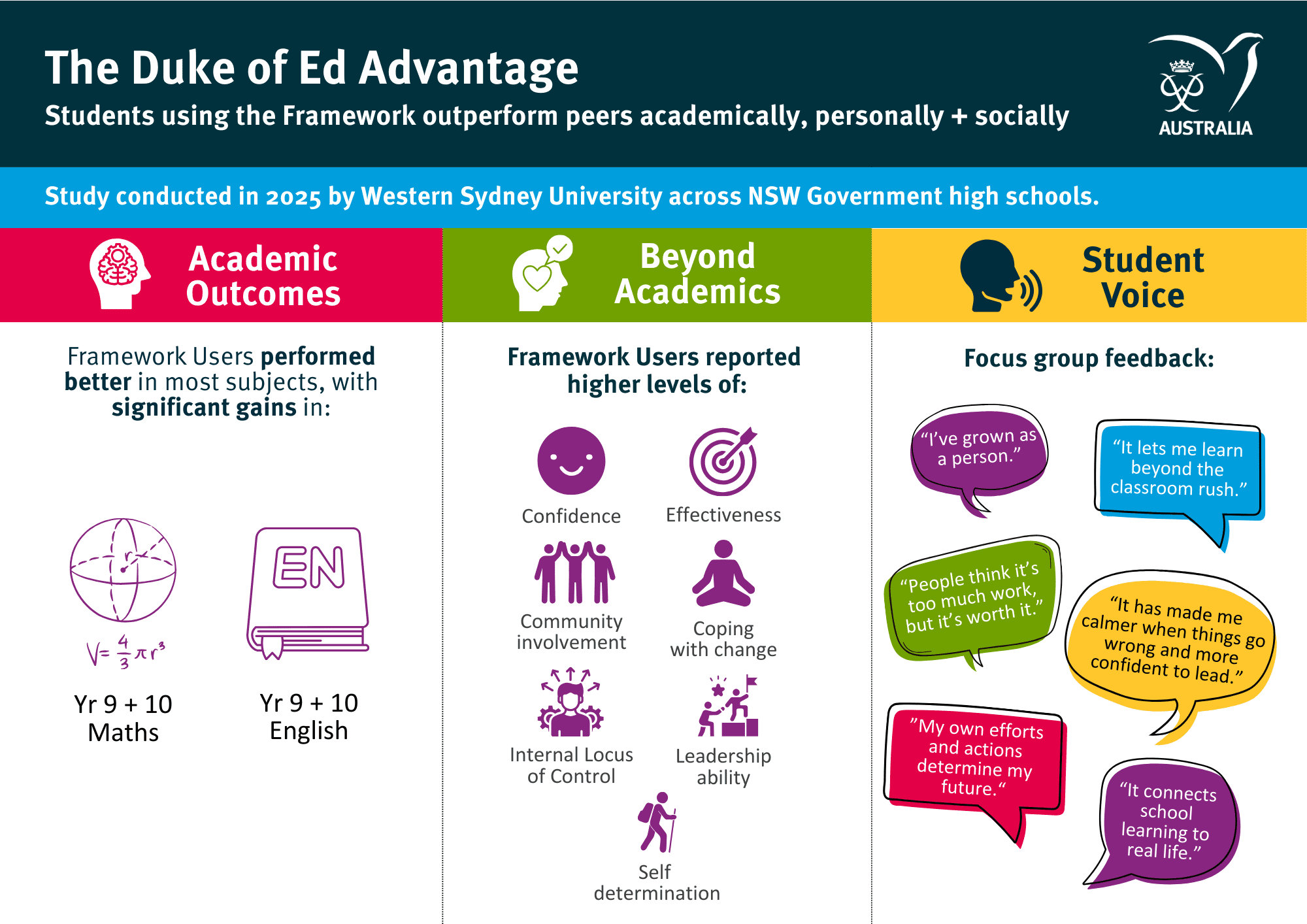
Students using the Duke of Ed Framework achieved higher school-awarded results across multiple cohorts, with the most notable gains in Years 9 and 10 English and Mathematics. Boys showed the strongest improvements, consistently outperforming their peers across all academic measures. Girls also demonstrated stronger average results across six of the ten subject–year combinations, indicating a positive academic trend for both groups.
Importantly, NAPLAN data showed no performance differences between the groups. This confirms that the higher school-based results can be attributed to using the Duke of Ed Framework, rather than pre-existing academic advantages.
A member of the Western Sydney University research team says “Students using the Duke of Ed Framework performed noticeably better than their peers in English and Maths across multiple year levels. For boys, the link between the Duke of Ed and academic success was especially strong.”
More Confident, Motivated and Community-Minded
Beyond academics, the research highlighted clear personal development benefits. Students using the Duke of Ed Framework reported higher confidence in their leadership abilities, stronger motivation and a greater sense of agency over their future.
They were also more involved in volunteering, sport and leadership activities, reinforcing the Duke of Ed’s emphasis on contribution, engagement and real-world skill-building.
A Proven Framework
For schools, this robust, university-validated evidence confirms what has long been suspected: that non-formal learning has measurable academic benefits. The Duke of Ed Framework supports students to build discipline, self-management, goal-setting habits and real-world application, all traits that translate directly into stronger engagement and achievement at school.
For policymakers, the research highlights a strategic opportunity: expanding student access to the Duke of Ed strengthens academic outcomes and cultivates leadership, wellbeing and resilience.
Investing in Young Australians
As schools continue to navigate complex learning environments, the study reinforces the value of structured, purposeful, non-formal learning. The Duke of Ed Framework provides young Australians with tools to thrive academically, personally and in their broader communities. The research highlights improved academic outcomes and the development of transferable skills that support successful transitions to work and further learning.
Duke of Ed Australia CEO, Peter Kaye AM LVO ESM, says “The study demonstrates that completing a Duke of Ed Level supports improved academic achievement, confidence and leadership thus strengthening both classroom performance and real-world readiness. These results confirm what many educators and Duke of Ed Alumni have long known: when young people are supported to challenge themselves, set goals and build skills beyond the classroom, they flourish.”
Access a full copy of the research, ‘A Comparative Study of NSW Public School Students Using and Not Using the Duke of Edinburgh’s International Award Framework: Academic Results and Attitudes - Western Sydney University’.
Access research
To learn more on the positive impact of the Duke of Ed: